





|
MIT Libraries:
DSpace Digital Repository Visualization
The information age is now an electronic age. Books, magazines and newspapers, business and government records, music, movies, email all are stored as electronic files that can only be read, played, or watched by people with the right hardware and software. Over time, changes in technology can make digital information simply incapable of being accessed. Furthermore, without separate authentication standards, digital information becomes untrustworthy. On both legal and historical grounds, people need to be able to verify a document's provenance and data integrity.
In 2000 the MIT Libraries teamed with the Hewlett-Packard Company to create DSpace, a digital data repository that addresses these challenges. DSpace couples a secure data storage network with sophisticated file management software. It is a scaleable, open source system designed for easy deployment on any computer platform. Yet this technology only provides half the solution. The other half comes from the policies and procedures that encourage people to use it.
The Challenge: Encourage Adoption of a Complex Technology
MIT and Hewlett Packard designed DSpace as a classic IT engineering project. As a result, many of the documents describing it are highly technical and don't provide a good overall view of the system for nontechnical users.
Knowing of our work, MIT asked Dynamic Diagrams to create a visual explanation of the DSpace technology. This visual explanation would aid internal communication between different teams working on the project, both technical and non-technical. It would also be coupled with articles and white papers as a quick, one-picture view of the DSpace approach. Potential adopters could then circulate the visualization among their own organizations to encourage support for the technology.
Our Solution: Orient the Explanation to the Data Path
Every visual explanation requires a viewpoint. Sometimes, this viewpoint can match that of a particular type of user. For DSpace we wished to show the entire system at once, which meant incorporating the views of at least three types of users: content creators who submit electronic files to a DSpace system, collection curators who organize and maintain it, and researchers who search and extract information from the growing repository. To tie these users' activities together we oriented our visualization to the data and the path it takes "through" the system.
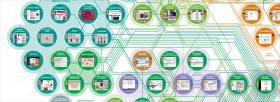
As a result, the visualization presents a clear, directional picture of a DSpace repository. Each user is shown in their proper relationship to a prototypical data path; the data is shown from its beginnings as separate, individual files to its ultimate organization into searchable, uniquely indexed collections and communities.
|
|